
Organization
The North American Weather Modification Council (NAWMC) was created on January 25, 2011 as a nonprofit 501(c)(4) corporation under the Texas Business Organizations Code. Its purpose is to advance and promote the proper use of weather modification technologies through education and research.

Membership
Application for membership shall be open to those organizations supporting the NAWMC and meeting any of the following membership criteria:
Full Member – Full membership is available to all states and territories of the United States of America and the Republic of Mexico, and to all Provinces of Canada. Full membership may be granted to that state or provincial agency having regulatory, operational, or programmatic control of weather modification activities in that state, territory or province. Each entity electing to become a Full Member of the Council shall affirm its decision by informing the Council of its support and by submitting an application for review and approval by the Council. Upon approval of its application and payment of dues, the entity shall appoint a delegate and an alternate to the Council. At meetings of the Council each Full Member shall have 1 vote. Annual dues are $500.
Associate Member – Associate membership is available to any national, state, provincial, regional, or local agency, association, or project sponsor involved in weather modification, if that state or province is a Full Member of the Council. Each entity electing to become an Associate Member of the Council shall affirm its decision by informing the Council of its support and by submitting an application for review and approval by the Council. In the event an entity’s state is not a Full Member of the Council, it may still request to join the Council as an Associate Member. The Council will then determine if the association may join as an Associate or an Affiliate Member. Associate membership is on an annual basis. Upon approval of its application and payment of dues, the entity shall appoint a delegate and an alternate to the Council. At meetings of the Council each state’s Associate Member(s) shall collectively have 1 vote, regardless of number. Annual dues are $500.
Affiliate Member – Affiliate membership in the Council is available to entities other than those being eligible for full or associate membership such as: professional organizations; universities; scientific societies; private companies whose primary business is not related to weather modification; non-profit organizations; and other entities that do not qualify for full membership or associate membership. The Board may create different classes of affiliate members. Each entity electing to become an affiliate member of the council shall affirm its decision by informing the Council of its support and by submitting an application for review and approval by the Council. Affiliate membership is on an annual basis. Upon approval of its application and payment of dues, the entity shall appoint a delegate and an alternate to the Council. At meetings of the Council Affiliate Members shall not vote. Annual dues are $250.
Basic Member – Basic membership in the Council is available to any state, territory, or province involved in weather modification. Basic membership may be granted to that state or provincial agency having regulatory, operational, or programmatic control of weather modification activities in that state, territory, or province. Each entity electing to become a Basic Member of the Council shall affirm its decision by informing the Council of its support and by submitting an application for review and approval by the Council. Upon approval of its application, the Basic Member shall appoint a delegate and an alternate to the Council. Basic Memberships are for two years and dues are not paid to the Council. At meetings of the Council, Basic Members shall not vote. There are no annual dues for Basic Members.
Current Members
Arizona
Central Arizona Water Conservation District (associate member) | Phoenix, AZ
Weather Modification activities support cloud seeding projects in the Upper Colorado River Basin that aim at generating greater runoff volumes in the Colorado River. Weather Modification is a jointly funded endeavor between the Central Arizona Project (CAP), Southern Nevada Water Authority (SNWA), and California’s six agency committee and targets cloud seeding operations in the states of Wyoming, Colorado, and Utah. These and many other weather modification activities are coordinated with the NAWMC.
Salt River Project (associate member) | Tempe, AZ
Salt River Project is a community-based, not-for-profit organization providing reliable, affordable and sustainable water and energy to more than 2 million people in central Arizona.
California
California Department of Water Resources (full member) | Sacramento, CA
Established in 1956 by the California State Legislature, California Department of Water Resources (DWR) protects, conserves, develops, and manages much of California’s water supply. This includes the State Water Project (SWP), the nation’s largest state-built water conveyance program.
DWR’s major responsibilities include:
- Overseeing the statewide process of developing and updating the California Water Plan (Bulletin 160 series)
- Planning, designing, constructing, operating, and maintaining the SWP
- Protecting and restoring the Sacramento-San Joaquin Delta
- Regulating dams, providing flood protection, and assisting in emergency management
- Working to preserve the natural environment and wildlife
- Educating the public about the importance of water, water conservation, and water safety
- Providing grants and technical assistance to service local water needs
- Collecting, analyzing, and reporting data in support of our mission to manage and protect California’s water resources
San Luis Obispo County (associate member) | San Luis Obispo, CA
The County of San Luis Obispo Flood Control and Water Conservation District recently initiated Year 2, of a potential 3-year program of the Winter Cloud Seeding Program for Lopez Lake (Zone 3). The project objective is to increase precipitation in the Lopez Lake watershed during winter precipitation events. The seeding program will use a combination of ground-seeding sites and aircraft.
Santa Ana Watershed Project Authority (associate member) | Riverside, CA
The Santa Ana Watershed Project Authority conducted a feasibility study in 2020 to assess the potential benefits of cloud seeding in increasing water supply in the Santa Ana River watershed. As a result of the study, the Santa Ana River Watershed Cloud Seeding Pilot Program is underway for four years, starting on November 15, 2023, and will continue through April 2027.
Santa Barbara County Water Agency (associate member) | Santa Barbara, CA
The Santa Barbara County Water Agency conducts a precipitation enhancement program, also known as “cloud seeding,” to augment natural precipitation to increase surface water runoff in watersheds behind the major water reservoirs. These reservoirs include Cachuma Reservoir, Gibraltar Dam, and Jameson Reservoir on the Santa Ynez River and Twitchell Reservoir on the Cuyama River near Santa Maria. The Department of Water Resources outlines the benefits of precipitation enhancement in the Resources Management Strategies of the California Water Plan.
The operational program has been in existence since 1981 and is based on research conducted between 1957 and 1974 which showed that significant increases in rainfall could be achieved by seeding convective bands during winter storm events.
Six Agency Committee (associate member) | Glendale, CA
Colorado
City of Grand Junction Water Enhancement Authority (associate member) | Grand Junction, CO
Water Services is committed to providing our customers with the highest quality and most reliable drinking water, at the lowest cost possible. We are responsible for diverting and storing raw water supplies from the Grand Mesa, processing that water at our treatment plant, distributing treated water, and assuring water quality during each step of the process.
Colorado River District (associate member) | Glenwood Springs, CO
The Colorado River District manages the Central Colorado Mountain River Basin cloud seeding program, which operates along the northern and central Rocky Mountains of Colorado. In total, the Colorado River District manages 24 cloud-seeding generators which seed clouds over portions of Eagle, Grand, Pitkin and Summit counties. Our partners make this possible with funding and technical support. Partners include member agencies of the Front Range Water Council, the Colorado Water Conservation Board, ski areas and water utilities in Arizona, southern California and Nevada.
Colorado Water Conservation Board (full member) | Denver, CO
The Colorado Water Conservation Board administers Colorado’s Weather Modification (WM) Program, which issues WM permits, monitors WM activities and keeps the public informed about the state’s WM activities. Colorado has conducted weather modification operations and research since the 1950s, and a program to permit weather modification has existed since 1972. After the significant drought starting in early 2000, many new WM permits have been developed. Colorado is a strategic state with the headwaters of eight major river basins, and downstream states are reliant on the snowpack and stream flow generated in Colorado.
Heritage Environmental Consultants, LLC (affiliate member) | Denver, CO
Heritage Environmental Consultants provides environmental planning, permitting, and science services to industry and government clients. These services can also be described as front-end environmental services focused on supporting project planning and development by complying with the regulatory, environmental, legal, and political constraints that may affect proposed projects.
Idaho
Idaho Department of Water Resources (full member) | Boise, ID
Idaho Water Resource Board supports programs such as technical studies, hydrologic monitoring, and water measurement. It operates a water exchange market and provides financial assistance for water development and conservation projects.
Idaho Power Company (associate member) | Boise, ID
Idaho Power meteorologists monitor winter storms as they pass across the central Idaho mountains, looking for opportunities to increase the amount of snow that falls in drainages that feed the Snake River.
The goal of our cloud-seeding program is to provide additional water for Idaho Power’s hydropower projects, which provide reliable, affordable, clean, energy for our customers. Increased snowpack also benefits irrigators, winter recreationists, river users, and fish and wildlife.
Nevada
Desert Research Institute (full member) | Reno, NV
During the early 1960s, scientists from the Desert Research Institute (DRI) helped to pioneer the science of wintertime cloud seeding, developing research-based methods for increasing winter snowpack and subsequent snowmelt runoff across mountainous regions of the Western US. Since the DRI Cloud Seeding Research Program’s early days, our team of experts has conducted continuous research and development to create time-tested cloud seeding methods that are proven to enhance snowfall from winter storms. DRI’s cloud seeding projects are conducted in an environmentally safe manner, increasing the precipitation formation efficiencies of passing clouds to support the water needs of local communities and ecosystems.
Southern Nevada Water Authority (associate member) | Las Vegas, NV
Southern Nevada gets about 90 percent of its water supply from the Colorado River, which begins as rain and snowmelt in the Rocky Mountains. The river serves about 40 million people across seven western states and the country of Mexico. The river is governed by a series of compacts, laws, court decisions, rules and treaties, collectively known as the “Law of the River.”
North Dakota
North Dakota Department of Water Resources (full member) | Bismarck, ND
The Department of Water Resources (DWR) has the authority to investigate, plan, construct, and develop water-related projects, and serves as a mechanism to financially support those efforts throughout North Dakota. There are six divisions that make up the DWR: Administration, Data & Atmospheric Resources, Planning and Education, Regulatory, Water Appropriation, and Water Development. The primary functions of the Data & Atmospheric Resources Division related to weather modification are to:
- Carry out administrative procedures required for the licensing of weather modification contractors and the permitting of cloud seeding operations and research activities;
- Develop and maintain a system for the collection of data and records of all operational weather modification activities;
- Conduct research into atmospheric precipitation processes to assess and improve the effectiveness of cloud seeding technology;
- Promulgate rules and regulations governing cloud seeding activities to ensure environmental and public safety;
- Monitor and evaluate cloud seeding activities and report back to sponsoring entities; and
- Monitor, collect, and disseminate accurate precipitation and climate data.
- Educate and provide information regarding the atmosphere and atmospheric processes.
North Dakota Weather Modification Association (associate member) | Bismarck, ND
Utah
Utah Division of Water Resources (full member) | Salt Lake City, UT
Utah has been cloud seeding since the early 1950s to help augment the state’s water supply. The Cloud Seeding Act of 1973 gave authority to the Utah Division of Water Resources to oversee state cloud seeding projects. The Utah Legislature continues to support operational cloud seeding activities and pushes for innovation in the field.
Cloud seeding takes place in Utah from the months of November and into April. It only occurs during snowfall events where atmospheric conditions (such as temperature and moisture) favor the enhancement of snow – never under clear conditions.
Wyoming
Wyoming Water Development Office (full member) | Cheyenne, WY
The State of Wyoming became interested in cloud seeding in the early 2000’s, as a way to address drought mitigation. In 2004, a 10-year robust study was conducted on the viability and efficiency of cloud seeding technology over Wyoming mountain ranges. In 2014, as a result of positive conclusions from Wyoming’s Weather Modification Pilot Study, cloud seeding operations began over the Wind River Mountain Range. Currently, operational cloud seeding efforts continue across parts of the state.
University of Wyoming Office of Water Projects (affiliate member) | Laramie, WY
The University of Wyoming’s Office of Water Programs (OWP), created in 2002 by the fifty-sixth Legislature of the State of Wyoming, is charged with identifying research needs of State and Federal agencies regarding Wyoming’s water resources and serving as a point of coordination to encourage water-related research activities by the University of Wyoming. The OWP works in conjunction with and reports to the Wyoming Water Development Commission (WWDC) and the Select Water Committee and provides the University’s advisor to the Wyoming Water Development Commission.
The Office of Water Programs administers the Wyoming Water Research Program (WRP), including activities under the National Institutes of Water Resources (NIWR). The WRP is a cooperative Federal, State, and University effort.
Other Related Organizations
Weather Modification Association
Weather Modification Association
The Weather Modification Association’s mission includes enabling persons, political entities, and other organizations to make informed decisions about the application of weather modification technologies, to provide for adequate water supplies, and reduced natural weather hazards.
Western Governors Association
The Western Governors’ Association represents the Governors of the 22 westernmost states and territories. The association is an instrument of the Governors for bipartisan policy development, information exchange, and collective action on issues of critical importance to the western United States.
Western States Water Council
The Western States Water Council is a government entity, an instrumentality of each and every participating state, consisting of representatives appointed by the governors of 18 western states. Since its creation, through adoption of a resolution at the Western Governors’ Conference in 1965, the Council has striven to fulfill its chartered purposes. The purposes of the Council are: (1) to accomplish effective cooperation among western states in the conservation, development and management of water resources; (2) to maintain vital state prerogatives, while identifying ways to accommodate legitimate federal interests; (3) to provide a forum for the exchange of views, perspectives, and experiences among member states; and (4) to provide analysis of federal and state developments in order to assist member states in evaluating impacts of federal laws and programs and the effectiveness of state laws and policies.
Current Project Map
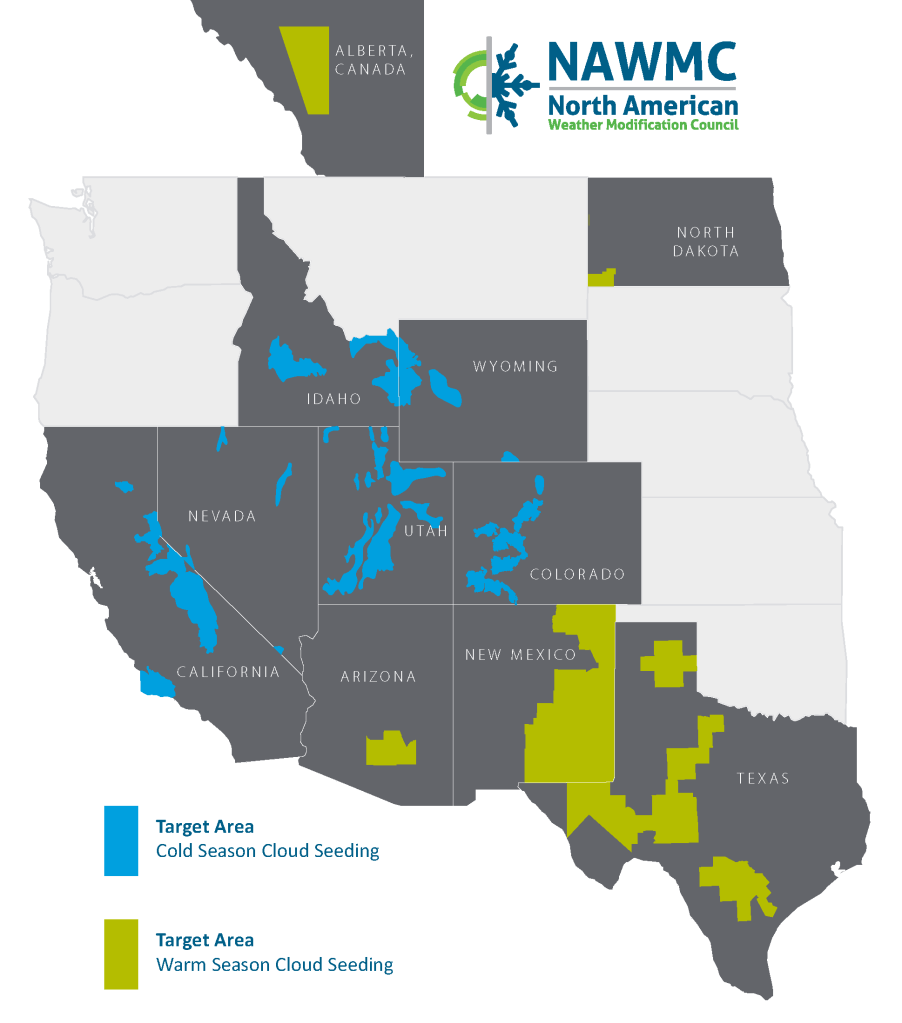
 North American Weather Modification Council