
Technology
The field of weather modification requires the use of specialized equipment to carry out operations and research. Cloud seeding materials, primarily silver iodide, have been extensively reviewed with regard to their environmental safety. Examples of some of the commonly used equipment, further explanation of the basic methods and techniques, more on environmental stewardship, and frequently asked questions can be found here.

Cloud Seeding Equipment
Cloud seeding can be applied from the ground or the air. Each is briefly described here.
Ground Generators

Silver Iodide ground generators release microscopic particles in or below cloud base which act as a nucleus for ice crystals to form, spurring precipitation development.
propane Generator

Gound-based propane generators work by virtue of liquid propane’s extremely cold temperature. They instantly condense and freeze liquid water droplets in super-cooled clouds.
Ejectable Flares

Ejectable flares are dispensed directly into growing cumulus clouds. The “candle” that is ejected contains approximately 20 grams of seeding material and burns completely in less than one minute, distributing the silver iodide nuclei inside the cloud.
Wing-Tip Generator

Airplane-mounted seeding generators are used primarily on summer cloudseeding programs and a few winter programs. They are operated either directly below cloud in the updraft, or in-cloud usually during winter operations in less turbulent conditions.
End-Burning Flares
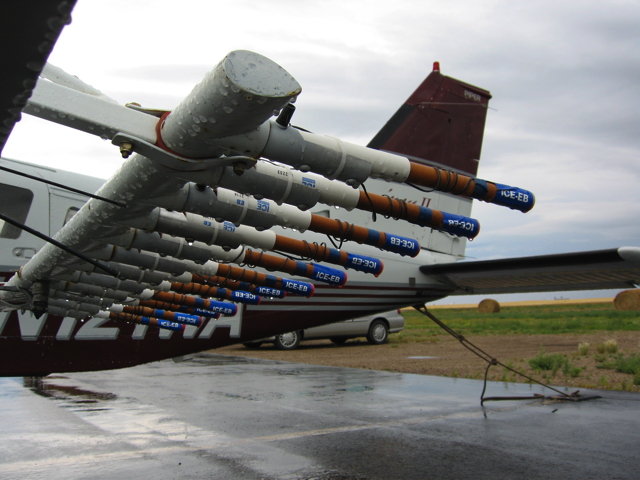
Burn-in-place, or end-burning flares emit a fine silver iodide smoke similar to that from ground-based or wing-tip mounted generators.
Hygroscopic Flares
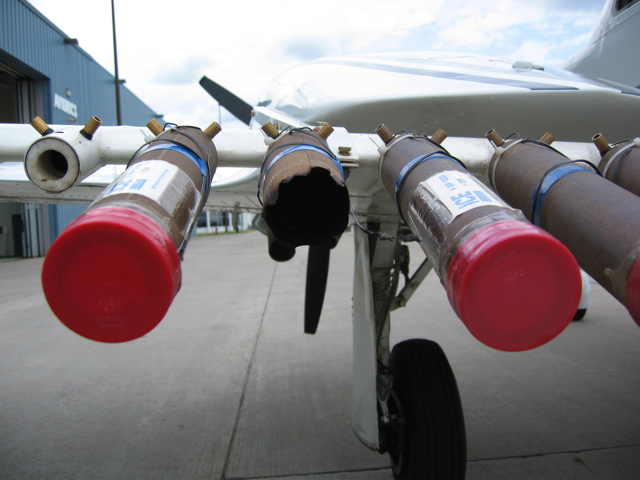
Hygroscopic flares like these are used in a similar fashion to silver iodide flares, but supply clouds with condensation nuclei to grow raindrops without the need for a freezing process.
Dry Ice Pellets

Dry ice pellets are used in some cloud seeding programs. They are dropped by airplanes in convective clouds during summer seeding programs to induce ice formation earlier than it would occur naturally. Dry ice acts differently than silver iodide as it simultaneously creates and then freezes supercooled droplets by virtue of its extremely cold surface temperature.
Dry Ice Seeding Demonstration
Watch dry ice fragments create ice crystals in a supercooled cloud in just seconds.
Seeding Methods
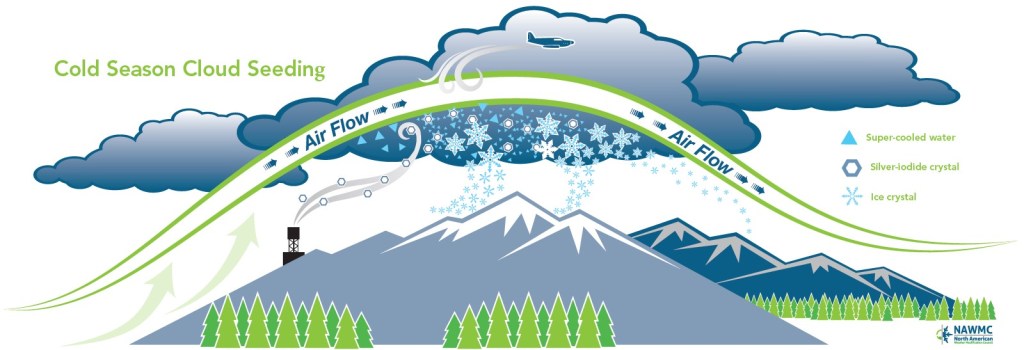
Winter and summer airborne and ground-based seeding concepts are described here.
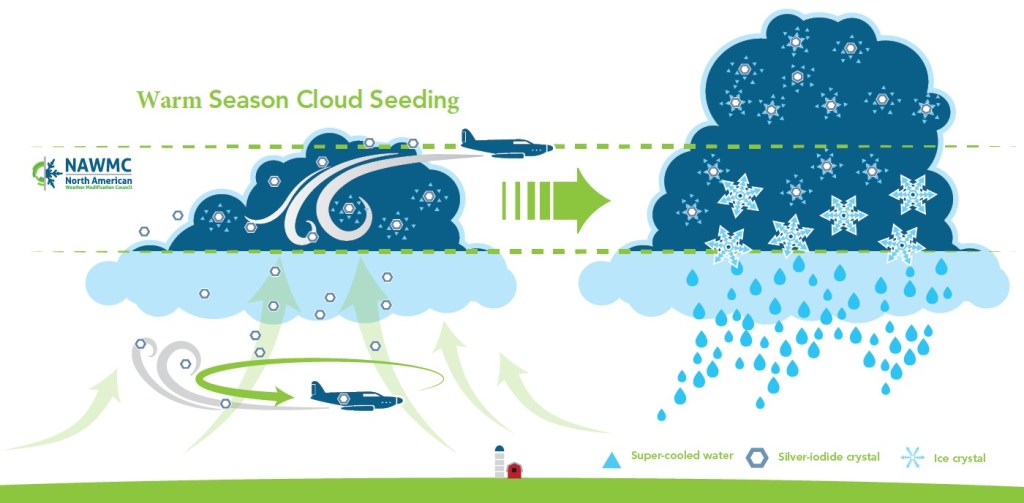
Summer cloud seeding in the updraft at cloud base and via direct-injection seeding near cloud top is illustrated.
Environmental Safety
Silver iodide is the primary seeding agent used in cloud seeding. Its tremendous efficiency as an ice nucleus allows it to be used in minute quantities. Silver iodide has been extensively reviewed as to its environmental safety during the last half-century. The published findings of this research clearly show no environmentally harmful effects arising from cloud seeding have been observed, or are expected to occur.
The Weather Modification Association (WMA) recently conducted a thorough review of published scientific literature on the environmental effects of silver iodide. Read the report of their findings here.
Professional Guidelines
American Society of Civil Engineers
The American Society of Civil Engineers (ASCE) supports:
- The careful and well-designed management of atmospheric water (also known as “weather modification” or “cloud seeding”) to enhance water supply, reduce agricultural and structural hail damage, and to disperse certain types of fog.
- Sustained funding and infrastructure for atmospheric water management data collection, research and operational programs, and the scientific evaluations of such efforts, including the assessment of extra-area and long-term environmental effects, resulting in further adjustments and designs.
- Dissemination of the results and findings of all atmospheric water management programs and projects to the professional community, water managers, and the public via publication of study results in peer-reviewed scientific journals.
Policy Statement 275- Atmospheric Water Resources Management
Guidelines for Purchase:
- Guidelines for Cloud Seeding to Augmenting Precipitation
- Guidelines for Operational Hail Suppression Programs
- Standard Practice for the Design and Operation of Supercooled Fog Dispersal Projects (44-13)
- Standard Practice for the Design, Conduct, and Evaluation of Operational Precipitation Enhancement Projects (42-17)
Frequently Asked Questions
Why is weather modification practiced?
Weather modification, commonly referred to as cloud seeding, is currently used to increase precipitation from clouds, reduce hail from thunderstorms, and eliminate fogs that reduce visibility, usually at busy airports.
How does cloud seeding work?
Cloud seeding improves a cloud’s ability to produce precipitation by adding tiny particles called ice nuclei (which water needs to freeze) to a cloud. These nuclei help the cloud produce precipitation by acting on supercooled liquid water (SLW), the raw material from which precipitation is formed. These artificial ice nuclei promote freezing of SLW at warmer temperatures than it would naturally, accelerating the precipitation process and making more efficient use of the water in the cloud.
Can all clouds be seeded effectively?
No. Only clouds that meet certain criteria are suitable for seeding. Summer clouds must possess a sustained updraft of moist air, a lack of natural ice, and grow to heights cold enough to contain supercooled liquid water. Winter clouds must also be supercooled and persist long enough to grow snowflakes large enough to fall to the ground. Criteria for fog seeding are very similar to the conditions required for winter clouds.
What are clouds seeded with?
Clouds can be seeded with a number of different types of agents: silver iodide, liquid propane, dry ice (solid carbon dioxide), and various salt compounds.
How long after seeding before a treated cloud starts to change?
Seeding effect can vary from almost immediate to around 30 minutes depending on the seeding delivery method and the type of cloud seeded. Directly placing seeding material in a cloud typically works more quickly than releasing the material below the cloud and allowing the cloud to ingest it.
Who decides if and when clouds are seeded?
Typically, a meteorologist is the director of operations for cloud seeding missions. A number of factors play a part in the decision-making process which includes local atmospheric conditions, weather forecasts, seeding suspension criteria, and aircraft safety concerns.
What methods are used to deliver seeding material to suitable clouds?
Seeding is typically done either by specially-equipped aircraft or via ground-based generators at higher elevations in mountainous areas.
Does rain or snow from a seeded cloud taste or smell different than natural precipitation?
No. There is no discernible difference between precipitation from a seeded cloud versus precipitation from a non-seeded cloud.
Can cloud seeding change weather patterns?
No. Cloud seeding may change individual clouds or groups of clouds, but weather patterns are determined by large-scale atmospheric conditions which cloud seeding cannot affect.
Can cloud seeding end droughts?
Though drought is sometimes the impetus for implementing a cloud seeding program, cloud seeding is not generally advocated for such purposes. The reason for this is that droughts are typically characterized by prolonged periods with a lack of precipitation-producing clouds. Therefore, cloud seeding opportunities during these periods would be very limited and the results likely marginal. A long-term and well designed cloud seeding program can potentially soften the impact of drought, however, as increased precipitation production before and after drought could temper the shortfall of precipitation during the drought period.
How do we know what happens inside clouds?
A number of scientific research experiments have been conducted from which we have learned much about the basic processes of precipitation initiation and development. Much of that knowledge has been applied to cloud seeding technology, thereby making cloud seeding more effective now than ever before. However, additional research is still needed to answer remaining questions and further improve cloud seeding practices.
How can seeding effects be measured?
Seeding effects and benefits can be demonstrated in a number of ways. The most direct method would be to conduct a project over several years in which half of the storms were randomly selected for seeding and the resulting precipitation from the seeded and unseeded storms were compared. The problem with this method, however, is that project sponsors usually want all of the seedable clouds treated (not half) to attain the maximum benefit possible from the program.
Evaluations of precipitation data, streamflow data, crop insurance data, and crop yield data are useful if done properly. These evaluations require long term climatological relationships to be established between seeded and unseeded areas, and a long period of operations for comparison purposes, but do not require that only half of the suitable clouds be treated.
Recently developed methods include snow trace-chemistry analysis, objective radar-based analysis, evaluation of satellite data, and even numerical modeling to help discern the effects of cloud seeding.
What are the typical benefits of cloud seeding?
Numerous evaluations have indicated that cloud seeding, when properly applied, can produce precipitation increases up to 10% or greater (AMS, 1998). Studies of hail suppression seeding indicate hail damage reductions up to 45% (Smith et al., 1997). Agricultural wheat production in seeded areas has increased by 5.9% in North Dakota (Smith et al., 1992).
What are the economic benefits of cloud seeding?
Evaluations indicate runoff from additional snowpack in the range from $1 to $15 per acre foot (Kansas Water Office, 2001). Benefit to cost ratios on summer season agricultural economic production approach 40 to 1 (Sell and Leistritz, 1998).
Who else is doing weather modification?
The latest data from the World Meteorological Organization compiled in 2000 listed 74 projects ongoing in 23 countries worldwide (WMO, 2000). In 2001 the National Oceanic and Atmospheric Administration (NOAA) documented 66 projects conducted in the western U.S. Project objectives included fog dispersal, snowpack and rainfall enhancement, and hail suppression.
Who performs cloud seeding operations?
On most U.S. programs, a company specializing in cloud seeding is hired to conduct seeding operations. Other programs are conducted by universities, private companies, or even local weather modification or water management entities.
What kind of training is required for weather modification personnel?
Prior experience in weather modification operations is a tremendous advantage to cloud seeding programs. Private contractors typically employ experienced personnel.
Pilots-in-command must meet certification and flight time requirements, while meteorologists must typically possess a Bachelor’s degree in Meteorology or Atmospheric Science. Many programs conduct pre-project training classes prior to project startup covering all pertinent aspects of the program.
A unique intern training program is sponsored by the North Dakota Atmospheric Resource Board. An intern pilot program, in cooperation with the University of North Dakota’s aviation program, trains pilots in summer convective cloud seeding each summer in North Dakota, while a parallel program for meteorology interns performs the same purpose for radar operators.
The Weather Modification Association maintains a certification program for meteorologists in the weather modification field. Certified Operator (CO) and Certified Manager (CM) status is available to those who meet specific operational and educational criteria.
What safeguards are in place during cloud seeding operations?
Safety measures are typically employed on cloud seeding projects in the U.S. These may include seeding suspensions in the event of specified snowpack thresholds, flooding potential, severe weather such as tornadoes or funnel clouds, and aircraft safety concerns such as severe icing or turbulence.
Who sponsors cloud seeding in the U.S.?
A wide range of entities sponsor cloud seeding programs in the U.S. They include municipal, county, and state governments; irrigation, water resource, and water conservation districts; airports; ski resorts; and private industry.
REFERENCES
AMS 1998: Planned and inadvertent weather modification. Bull. Am. Meteorol. Soc., 73, 331-37.
Sell, R.S., and F.L. Leistritz, 1998: Economic Impact of Reducing Hail and Enhancing Rainfall in North Dakota. 29 p.
Smith, P.L., Jr., L.R. Johnson, D.L. Priegnitz, and P.W. Mielke, Jr., 1992: A Target-Control Analysis of Wheat Yield Data for the North Dakota Cloud Modification Project Region. Journal of Weather Modification, 24, 98-105.
Smith, P.L., Jr., L.R. Johnson, D.L. Priegnitz, B.A. Boe, and P.W. Mielke, 1997: An Exploratory Analysis of Crop Hail Insurance Data for Evidence of Cloud Seeding Effects in North Dakota. Journal of Applied Meteorology, 36, 463-473.
Register of Weather Modification Projects 2000 (TD No. 1094): World Meteorological Organization, 2000.
Weather Modification Program, Fact Sheet No. 18, 2001: Kansas Water Office, 1p.
The current NAWMC membership includes state agencies in North Dakota, Kansas, Oklahoma, Texas, Colorado, Wyoming, Utah, Nevada and California
 North American Weather Modification Council